
-
Amicus Brief for the En Banc Sixth Circuit on the Scope of the Congressional Review Act’s “Substantially the Same” Test
Court Filings / October 1, 2026 / DownloadIn recent years, Congress has extensively used the Congressional Review Act (CRA) to veto agency rules. A CRA resolution not only rescinds the agency rule, but prevents the agency from ever reissuing a rule that is “substantially the same” as the disapproved rule. This case tests the meaning of “substantially the same.” Our brief defends a prior Sixth Circuit panel’s ruling, explaining that the CRA’s “substantially the same” test looks at the entire rule, not each provision separately. Our brief analyzes the CRA’s text, caselaw, legislative history, and Congressional practice to support this argument. It also explains that Petitioners’ reading is untenable and would produce unprecedented and highly odd results. The interpretation of the “substantially the same” provision will have significant implications for agency authority following a CRA resolution.
-
Comments to the Department of Housing and Urban Development on Its Proposed Rescission of Updated Floodplain Management Standards
Public Comments / September 4, 2026 / DownloadIn 2024, the Department of Housing and Urban Development (HUD) updated its floodplain management standards to increase the resilience of HUD-assisted and -insured projects to the effects of climate change (2024 Rule). In particular, the 2024 Rule modernized HUD’s approach to defining the floodplain by incorporating forward-looking information that reflects climate change’s effects on flood risk. HUD now proposes to rescind that rule, relying on poorly supported economic arguments. Policy Integrity submitted a comment letter regarding HUD’s Proposed Rule that raises several criticisms.
-
Comments to EPA on Proposed Revisions to Emissions Standards for Heavy-Duty Engines and Vehicles
Public Comments / August 28, 2026 / DownloadIn 2023, EPA updated its emissions standards for heavy-duty engines and vehicles, but the agency now seeks to weaken many provisions of the 2023 Rule and spurns decades of agency practice and an enormous scientific record by declining to incorporate in its analysis any estimates of the impact of increased concentrations of particulate matter and ozone on human health. We submitted comments to EPA, along with our partners at Clean Air Task Force, Environmental Defense Fund, Montana Environmental Information Center, Natural Resources Defense Council, Sierra Club, and Union of Concerned Scientists, explaining that the agency’s new claim that these estimates are too uncertain is flawed for numerous reasons.
-
Comments to the Department of Energy Challenging Proposed Revisions to Its Appliance Process Rule
Public Comments / August 21, 2026 / DownloadThe Institute for Policy Integrity submitted comments to the Department of Energy opposing proposed revisions to its Process Rule for setting appliance and equipment energy conservation standards under the Energy Policy and Conservation Act. The comments detail five critical legal and analytical flaws in the agency's proposed framework.
-
Comments to the Securities and Exchange Commission About Its Proposed Rescission of Climate-Related Financial Disclosures
Public Comments / August 3, 2026 / DownloadIn March 2024, the Securities and Exchange Commission (SEC) issued final rules that require public companies and other securities issuers in the United States to disclose certain climate-related financial information in their registration statements and periodic reports. In April 2024, the SEC voluntarily stayed the 2024 Rules pending the resolution of litigation that remains ongoing. Now, under new leadership after the change in presidential administration, the SEC has proposed to rescind the 2024 Rules altogether. Policy Integrity commented on the proposed rescission, raising several criticisms.
-
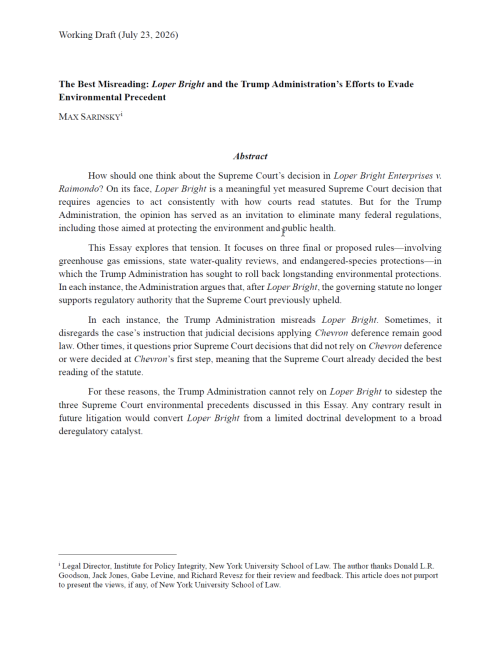
The Best Misreading: Loper Bright and the Trump Administration's Efforts to Evade Environmental Precedent
Working Paper
How should one think about the Supreme Court's decision in Loper Bright Enterprises v. Raimondo? On its face, Loper Bright is a meaningful yet measured Supreme Court decision that requires agencies to act consistently with how courts read statutes. But for the Trump Administration, the opinion has served as an invitation to eliminate many federal regulations, including those aimed at protecting the environment and public health.
-
Comments to the Coast Guard on Its Methodology for Estimating the Benefits of Avoiding Oil Spills
Public Comments / July 28, 2026 / DownloadPolicy Integrity submitted a comment letter on the U.S. Coast Guard’s updated methodology for estimating the benefits of avoiding oil spills, which revises the agency’s 2008 estimates of oil spill damages for use in regulatory analyses. The comment letter focuses on improving the robustness and transparency of the avoided-cost approach used in the Coast Guard’s analysis.
-
Comments to EPA on Its Proposed Maximum Containment Levels for PFAS
Public Comments / July 22, 2026 / DownloadIn 2024, the Environmental Protection Agency (EPA) set Maximum Contaminant Levels for six types of per- and polyfluoroalkyl substances (PFAS) under the Safe Drinking Water Act. Policy Integrity submitted a comment letter regarding EPA’s proposal to allow certain public water systems to request an additional two years to meet the standards for perfluorooctanoic acid and perfluorooctane sulfonic acid.
-
Comments to EPA About Its Proposed Hydrofluorocarbon Leak-Repair Exemption for Certain Refrigerators
Public Comments / July 10, 2026 / DownloadIn 2024, EPA promulgated a final rule, Phasedown of Hydrofluorocarbons: Management of Certain Hydrofluorocarbons and Substitutes Under the American Innovation and Manufacturing Act of 2020. The 2024 Rule instituted leak-repair requirements for certain refrigerant-containing appliances containing hydrofluorocarbons (HFCs) or equivalents. HFCs are potent greenhouse gases (GHGs). EPA now apparently seeks to categorically exempt 360,000 road and intermodal container transport refrigeration units from the 2024 Rule’s leak-repair requirements. This letter identifies three legal flaws in the Proposed Rule.
-
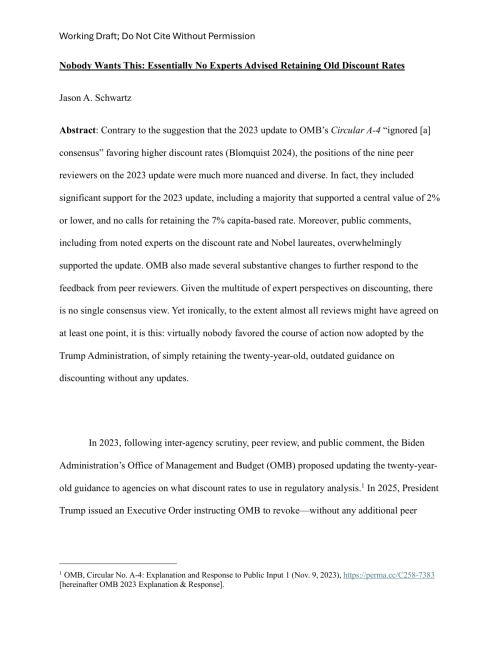
Nobody Wants This: Essentially No Experts Advised Retaining Old Discount Rates
Working Paper
Contrary to the suggestion that the 2023 update to the Office of Management and Budget’s Circular A-4 “ignored [a] consensus” favoring higher discount rates, the positions of the nine peer reviewers on the 2023 update were much more nuanced and diverse. Yet ironically, to the extent almost all reviews might have agreed on at least one point, it is this: virtually nobody favored the course of action now adopted by the Trump Administration, of simply retaining the twenty-year-old, outdated guidance on discounting without any updates.
Viewing recent projects in Recent Federal Action