
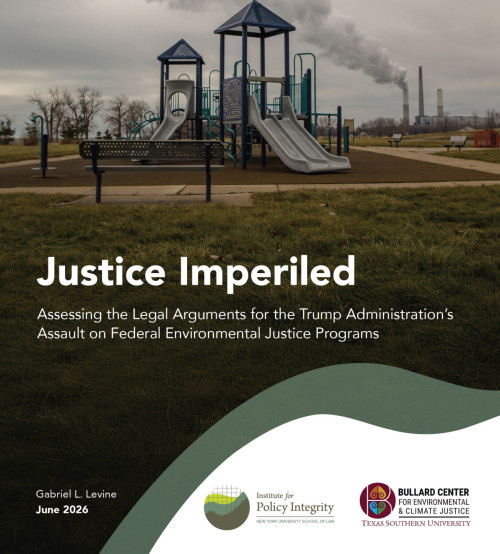
Since re-assuming office, President Trump and his administration have rescinded executive orders requiring consideration of environmental inequities, terminated the jobs of agency staff responsible for carrying out those orders, and revoked rules protecting public health in vulnerable communities. In the process, the Trump Administration has broken from three decades of bipartisan (if fluctuating) support for redressing environmental inequities.
But the administration has used weak legal arguments to justify these rollbacks. This report, co-published with the Robert D. Bullard Center for Environmental and Climate Justice, examines these arguments. Most notably, the Supreme Court’s Supreme Court’s recent decisions about affirmative action do not render environmental justice initiatives categorically unlawful, although they do impose meaningful constraints. Just as importantly, nothing in the Supreme Court’s 2023 decision in Students for Fair Admissions, Inc. v. President & Fellows of Harvard College prevents the government from considering the historical legacies of racism, even if that decision generally restricts them from considering present-day racial demographics.