
The Trump Administration has undertaken an aggressive deregulatory agenda, which has included numerous harmful actions targeting beneficial environmental and energy rules. In response, we’ve published a suite of resources and commentary focused on the legal, economic, and policy context of these actions.

Climate and Environmental Regulation
The Trump Administration is aggressively rescinding existing climate and environmental regulations under the Clean Air Act. Our resources challenge the Environmental Protection Agency’s flawed justifications for deregulation and explains the benefits of pollution controls.

Administrative Law
The Trump Administration has repeatedly attempted to circumvent the foundational requirements of the Administrative Procedure Act by advancing legal theories that prioritize speed over reasoned decisionmaking. Our resources reinforce the principle that agencies cannot ignore the harmful impacts of their actions or bypass the public’s right to provide input.

Energy Policy
The Trump Administration’s energy agenda has largely supported uneconomic coal plants and slowed or stopped clean energy and electricity transmission development. Our work in this area rebuts the technical, economic, and legal justifications for these interventions, documenting how these policies would increase costs and fail to improve reliability.

Scientific and Economic Integrity
The Trump Administration has frequently departed from long-standing best practices for economic and scientific integrity. These resources reinforce the principle that federal policy must be grounded in the best available science and evenhanded economic analysis.
Latest Resources
-
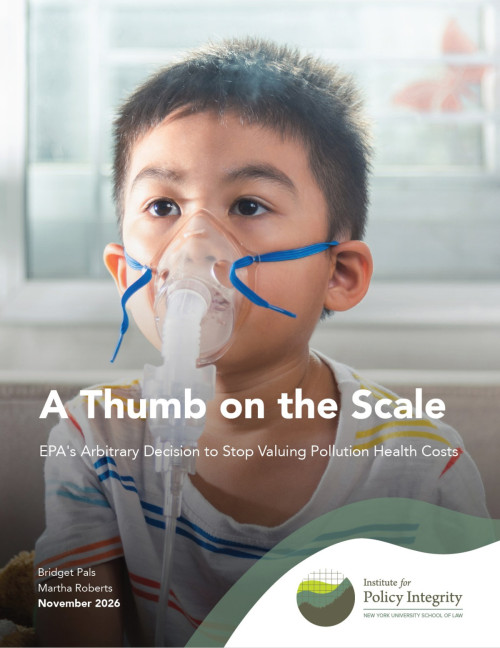
A Thumb on the Scale
EPA’s Arbitrary Decision To Stop Valuing Pollution Health Costs
Soot and smog pollution cause early deaths, asthma attacks, emergency room visits, neurological damage, and other harmful health effects. The Environmental Protection Agency (EPA) has refined its understanding of these impacts over decades to better inform the public as well as its own decisionmaking. Yet in January 2026 EPA abruptly decided to reject its extraordinarily well-established estimates of human health impacts from pollution. In this report, we explain why EPA’s omission of well-understood and well-established estimates of pollution impacts is arbitrary and capricious. EPA should return to its longstanding approach of quantifying and monetizing the harms of soot and smog.
-
Comments to the Environmental Protection Agency on Its Repeal of Greenhouse Gas Emission Standards for Power Plants
In September 2026, the Environmental Protection Agency (EPA) took two actions to repeal greenhouse gas emission standards for power plants. The first action finalized the repeal of key greenhouse gas standards for power plants because EPA changed its position regarding the standards’ technical feasibility and cost reasonableness. In the second action, EPA proposed to repeal all remaining greenhouse gas emission standards for fossil-fuel-fired power plants. In our comments on EPA’s proposal, we offer insights on fundamental legal and factual flaws in EPA’s proposed and recommend that EPA withdraw it.
-
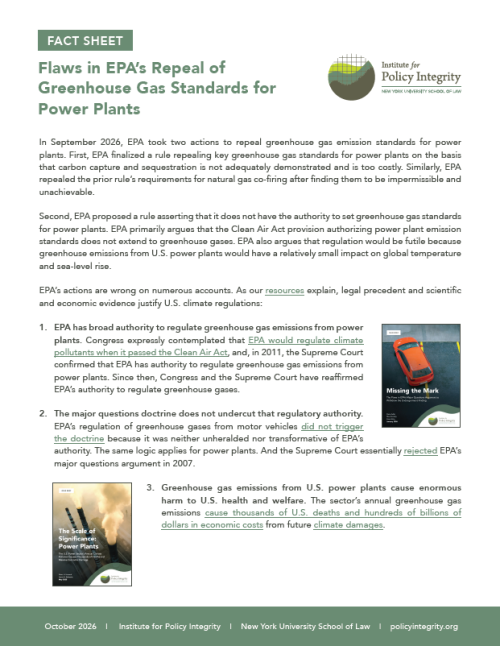
Fact Sheet: Flaws in EPA’s Repeal of Greenhouse Gas Standards for Power Plants
In this fact sheet, we lay out legal precedent and scientific and economic evidence that justify U.S. climate regulations, contrary to arguments made by the Environmental Protection Agency in a recent repeal of key limits on greenhouse gas emissions from the power sector and a proposed rule asserting the agency does not have authority to regulate these emissions.
-
Amicus Brief for the U.S. Court of Appeals for the D.C. Circuit on the Environmental Protection Agency’s 2026 Rollback of Hydrofluorocarbon Restrictions
In 2023, the U.S. Environmental Protection Agency issued a rule under the American Innovation and Manufacturing (AIM) Act restricting the use of certain hydrofluorocarbons (HFCs). HFCs are potent greenhouse gases used in refrigeration and other proccesses. In May 2026, EPA issued a rule relaxing some of those restrictions. Policy Integrity submitted an amicus brief in the U.S. Court of Appeals for the D.C. Circuit supporting the petitioners challenging the 2026 rule. Our brief argues that EPA’s failure to meaningfully consider the Final Rule’s climate impacts violates the AIM Act and is arbitrary and capricious. It also argues that EPA made the rule effective far sooner than the AIM Act allows.
-
Comments to the Bureau of Safety and Environmental Enforcement and the Bureau of Ocean Energy Management on Their Proposed Rollback of Arctic Offshore Drilling Regulations
The Bureau of Safety and Environmental Enforcement and the Bureau of Ocean Energy Management (collectively, the Joint Bureaus) developed this Proposed Rule in response to Executive Order 14,514 and federal agencies’ subsequent review of regulations affecting domestic energy production. The Proposed Rule expands the definition of the Arctic Outer Continental Shelf, permits the use of subsea isolation devices instead of nearby relief rigs for oil spill management, and allows leaseholders to drill throughout the entire open-water season. The Joint Bureaus do not adequately quantify the forgone benefits of the preexisting, more environmentally protective leasing program and overestimate the cost savings of the Proposed Rule, skewing their analysis. Policy Integrity submitted a comment letter regarding the Joint Bureaus’ Proposed Rule that raises several criticisms.
-
Amicus Brief for the En Banc Sixth Circuit on the Scope of the Congressional Review Act’s “Substantially the Same” Test
In recent years, Congress has extensively used the Congressional Review Act (CRA) to veto agency rules. A CRA resolution not only rescinds the agency rule, but prevents the agency from ever reissuing a rule that is “substantially the same” as the disapproved rule. This case tests the meaning of “substantially the same.” Our brief defends a prior Sixth Circuit panel’s ruling, explaining that the CRA’s “substantially the same” test looks at the entire rule, not each provision separately. Our brief analyzes the CRA’s text, caselaw, regulatory history, and Congressional practice to support this argument. It also explains that Petitioners’ reading is untenable and would produce unprecedented and highly odd results. The interpretation of the “substantially the same” provision will have significant implications for agency authority following a CRA resolution.
-
Comments to the Department of Housing and Urban Development on Its Proposed Rescission of Updated Floodplain Management Standards
In 2024, the Department of Housing and Urban Development (HUD) updated its floodplain management standards to increase the resilience of HUD-assisted and -insured projects to the effects of climate change (2024 Rule). In particular, the 2024 Rule modernized HUD’s approach to defining the floodplain by incorporating forward-looking information that reflects climate change’s effects on flood risk. HUD now proposes to rescind that rule, relying on poorly supported economic arguments. Policy Integrity submitted a comment letter regarding HUD’s Proposed Rule that raises several criticisms.
-
Comments to EPA on Proposed Revisions to Emissions Standards for Heavy-Duty Engines and Vehicles
In 2023, EPA updated its emissions standards for heavy-duty engines and vehicles, but the agency now seeks to weaken many provisions of the 2023 Rule and spurns decades of agency practice and an enormous scientific record by declining to incorporate in its analysis any estimates of the impact of increased concentrations of particulate matter and ozone on human health. We submitted comments to EPA, along with our partners at Clean Air Task Force, Environmental Defense Fund, Montana Environmental Information Center, Natural Resources Defense Council, Sierra Club, and Union of Concerned Scientists, explaining that the agency’s new claim that these estimates are too uncertain is flawed for numerous reasons.
-
Comments to the Department of Energy Challenging Proposed Revisions to Its Appliance Process Rule
The Institute for Policy Integrity submitted comments to the Department of Energy (DOE) opposing proposed revisions to its Process Rule for setting appliance and equipment energy conservation standards under the Energy Policy and Conservation Act (EPCA). The comments detail five critical legal and analytical flaws in DOE's proposed framework.
-
Comments to the Securities and Exchange Commission About Its Proposed Rescission of Climate-Related Financial Disclosures
In March 2024, the Securities and Exchange Commission (SEC) issued final rules that require public companies and other securities issuers in the United States to disclose certain climate-related financial information in their registration statements and periodic reports. In April 2024, the SEC voluntarily stayed the 2024 Rules pending the resolution of litigation that remains ongoing. Now, under new leadership after the change in presidential administration, the SEC has proposed to rescind the 2024 Rules altogether. Policy Integrity commented on the proposed rescission, raising several criticisms.
Recent Commentary-


-

-


-

-

-

-

-

Inside the Political Push To Dismantle EPA’s Climate Authority
News Clip / Politico / November 2, 2026
Federal Energy Regulatory Commission’s Pared Down Air Requirements Could Further Litigation Risk
News Clip / Bloomberg Law / November 2, 2026
Opinion — EPA Regulation of Toxic Chemicals Is in Doubt After East Fork
News Clip / Bloomberg Law / October 22, 2026
Opinion — The High Cost of Trump’s Backward Fuel Policy
News Clip / The Hill / October 20, 2026
Opinion — The Cynicism of Trump’s Climate Policy
News Clip / The Atlantic / October 20, 2026
Environmental Groups Push Back Against EPA Delays on Regulating Big Oil, Gas
News Clip / Medill on the Hill / October 15, 2026
Trump Officials Mislead About Electrical Grid Reliability
News Clip / FactCheck.org / October 13, 2026
Trump Plows Ahead on Fuel Economy as Courts Stay Silent
News Clip / Politico / September 30, 2026
View All