
-
Within Its Wheelhouse
EPA’s Latest Power Plant Regulations Rely on Traditional Approaches Left Available After West Virginia v. EPA
In May 2023, EPA proposed new limits for greenhouse gas (GHG) emissions from certain fossil-fuel-fired power plants under Section 111 of the Clean Air Act. Some critics have suggested that EPA’s new rule triggers the major questions doctrine. Under that doctrine, a court should look skeptically on the agency action in extraordinary cases involving unprecedented and transformative applications of agency authority. But the major questions doctrine is inapplicable to EPA’s use of CCS in its proposed regulations. Rather than propose a new approach that would transform its exercise of statutory authority, EPA has embraced one of its most traditional and well-established regulatory practices: setting emission limits based on pollution controls that cause a regulated source to operate more cleanly. This policy brief details why EPA’s latest proposal to limit GHG emissions from power plants fits neatly within the bounds of the legal authority left intact after West Virginia. It then explains how states and operators retain flexibility to use emission trading and averaging programs to implement EPA’s regulations.
-
Defining “Adequately Demonstrated”
EPA’s Long History of Forward-Looking Standards Under Section 111 of the Clean Air Act
In May 2023, the Environmental Protection Agency (EPA) proposed new limits for greenhouse gas (GHG) emissions from certain fossil-fuel-fired power plants under Section 111 of the Clean Air Act. Section 111 requires EPA to set limits reflecting the emission reductions achievable by applying what the agency determines to be the “best system of emission reduction” (BSER) that “has been adequately demonstrated,” and that meets certain other statutory factors. This policy brief summarizes the legal framework of Section 111 (including the legislative history and caselaw relevant to understanding its technology-forcing nature), walks through how courts have interpreted “adequately demonstrated,” reviews EPA’s past use of Section 111 to drive technology improvements, and explains why a potential Supreme Court decision that eliminates or curtails Chevron deference (a legal doctrine providing deference to reasonable agency interpretations of ambiguous statutory language) would not affect the longstanding interpretation of “adequately demonstrated.”
-
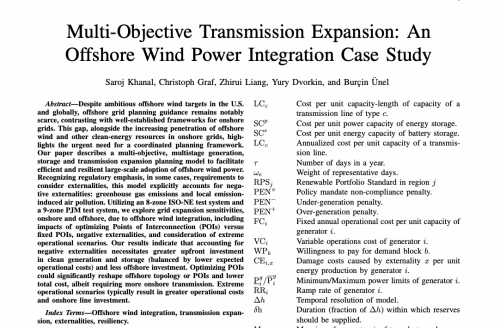
Multi-Objective Transmission Expansion
An Offshore Wind Power Integration Case Study
Our paper describes a multi-objective, multistage generation, storage and transmission expansion planning model to facilitate efficient and resilient large-scale adoption of offshore wind power. Recognizing regulatory emphasis and, in some cases, requirements to consider externalities, this model explicitly accounts for negative externalities: greenhouse gas emissions and local emission-induced air pollution. Our results indicate that accounting for negative externalities necessitates greater upfront investment in clean generation and storage (balanced by lower expected operational costs). Optimizing POIs could significantly reshape offshore topology or POIs, and lower total cost. Finally, accounting for extreme operational scenarios typically results in greater operational costs and sometimes may alter onshore line investment.
-
Comments to the Army Corps of Engineers on Agency Specific Procedures to Implement the Principles, Requirements, and Guidelines for Water Resources Investments
Public Comments / April 15, 2024 / DownloadIn February 2024, the Army Corps of Engineers proposed a series of procedures to implement the governmentwide Principles, Requirements, and Guidelines for water-resource projects. The “heart” of these agency-specific procedures (ASPs) is ensuring that decisionmakers consider a wide suite of economic, environmental, and social benefits and costs as they invest in such projects. The proposal reasonably moves the Corps away from its historical and inefficiently narrow focus on national economic development to the exclusion of other essential objectives like environmental quality and distributional considerations. While the proposal takes valuable steps toward more comprehensive accounting of societal benefits and improved decisionmaking, our comments recommended several reasonable steps the Corps can take to make these ASPs even more effective.
-
Comments to Montana PSC on Petition for Rulemaking on Consideration of Climate Impacts
Public Comments / April 10, 2024 / DownloadIn February, a coalition of public-interest organizations filed a petition for rulemaking requesting that the Montana Public Service Commission consider climate change in its regulation of electric and gas utilities. The Petition for Rulemaking calls on the Commission to consider the impacts of climate change in its proceedings using the Environmental Protection Agency’s latest estimates of the social cost of greenhouse gases. In support of the petition, we submitted comments offering a few helpful insights.
-
Comments to New York DEC and NYSERDA on Draft Climate Act Disadvantaged Communities Investment and Benefits Reporting Guidance
Public Comments / April 5, 2024 / DownloadIn December 2023, the New York State Department of Environmental Conservation and New York State Energy Research and Development Authority released the Draft Climate Act Disadvantaged Communities Investment and Benefits Reporting Guidance for public comment. The draft guidance proposed a methodology to be used by New York State agencies, authorities, and entities to account for and report the benefits of their clean energy and energy efficiency spending accrued in disadvantaged communities and across the state overall. This information will then be used to calculate the State’s compliance with the Climate Leadership and Community Protection Act’s requirement that a minimum of 35 percent, with a goal of 40 percent, of the benefits of clean energy and energy efficiency spending accrue to disadvantaged communities. In comments, we gave suggestions on how to improve the guidance.
-
Comments to CFPB on Regulation of Overdraft Lending by Very Large Financial Institutions
Public Comments / April 2, 2024 / DownloadIn February, the Consumer Financial Protection Bureau proposed a rule that would regulate overdraft lending by very large financial institutions. Overdraft fees amount to billions of dollars a year, and those costs are disproportionately borne by low-income households. The Proposed Rule would narrow regulatory exemptions that previously enabled banks extending overdraft credit to avoid complying with the regulatory requirements otherwise imposed on credit products. The Proposed Rule reflects a well-reasoned approach to correct market failures in the overdraft credit market, mitigating harms to consumers. We submitted comments suggesting how CFPB should improve its analysis.
-
Hydrogen Co-Firing and the EPA’s Greenhouse Gas Limits for Power Plants
Policy Strategies for Meaningful Emission Reductions
In May 2023, EPA proposed new limits for carbon dioxide emissions from fossil fuel-fired power plants. The proposed rule reflects a decade of careful development from EPA and embraces an approach consistent with the Supreme Court’s ruling in West Virginia v. EPA. In order to follow that approach, EPA based the limits for certain natural gas-fired turbines on the emission reductions achievable through hydrogen co-firing (i.e., burning a blend of natural gas and hydrogen). Unlike fossil fuels, hydrogen does not release CO2 when burned, but producing hydrogen can cause significant greenhouse gas (GHG) emissions depending on how its produced. Given these potential emissions, it is important to consider what type of hydrogen a power plant will co-fire with—otherwise this approach to reducing emissions could exacerbate climate change. This report explains the role of hydrogen co-firing in EPA’s proposed rule, discusses how EPA should design its final rules to achieve the specified GHG-reduction goals, and highlights additional actions that EPA and other regulators can take to further minimize the emissions (and the resulting climate harm) from hydrogen co-firing.
-
Amicus Brief on Major Questions Doctrine in Fifth Circuit Case Over DOL’s 2022 Investment Duties Rule
Court Filings / March 26, 2024 / DownloadWe filed an amicus brief in the Fifth Circuit arguing that the lower court correctly concluded the Department of Labor's 2022 Investment Duties Rule does not trigger the major questions doctrine because past regulatory practice demonstrated the case was not extraordinary enough to trigger the doctrine. Our brief explains that parties often invoke the major questions doctrine when they oppose an agency’s action without closely following the analysis in West Virginia v. EPA, 142 S. Ct. 2587 (2022), or the Supreme Court’s other recent cases applying the doctrine. -
Comments to EPA on New Effluent Standards for Meat and Poultry Facilities
Public Comments / March 25, 2024 / DownloadIn January 2024, the Environmental Protection Agency (EPA) proposed a regulation under the Clean Water Act that would impose new effluent limitations guidelines and standards for the meat and poultry products point source category. As EPA documents, the proposed standards would help improve health and water quality near these slaughterhouse facilities. It would also carry benefits stemming from better-protected habitats for a variety of wild animals. In our comment letter, we explain that, while the Proposed Rule and its accompanying regulatory impact analysis reasonably explain many of these benefits, EPA should take further steps to ensure the complete presentation of regulatory benefits and costs, along with their distribution, and to present its decisionmaking factors transparently.